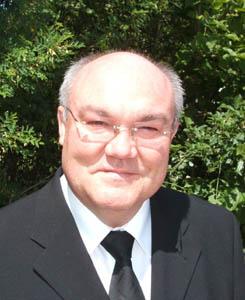
| Name: Bernt Koberstein | Profession: |
| Relationship: | Country: |
| New Apostolic Church
Dieburg. The festive divine service on 7 May 2006 took place in Dieburg in the administrative district of Darmstadt: Chief Apostle Wilhelm Leber retired two long-serving apostles and went on to ordain two new apostles, namely Bernd Koberstein and Jens Lindemann. Some 20,000 New Apostolic Christians watched and listened—both live and via satellite—as the international Church president, Chief Apostle Wilhelm Leber, retired two tried and tested clergymen. Apostle Heinz Kreuzberger (65) was able to look back on 41 years of ministerial activity, the last ten of which he served as an apostle. Among other things, he was also rector of the congregation of Athens, Greece for eight years. Apostle Willi Sommer (65) had been a minister of the New Apostolic Church for 48 years, during which time he also served in Turkey and in the Middle East, among other places. The names of their two successors had already been announced weeks before: Bernd Koberstein (54) lives in Bensheim, and Jens Lindemann (43) lives in Linden. The chief apostle wished both servants of God much strength for the new ministerial commission they had received. They will take over the districts of their predecessors. Chief Apostle Leber based the festive divine service on a portion of a Bible passage from Colossians 1: 18: “He … is the beginning, the firstborn from the dead, that in all things He may have the pre-eminence.” The Church leader explained that we too should allow Christ to have first place in our lives. Those who give Him first place cannot help but make clear decisions, he said. The divine service was set to a musical backdrop of choir and orchestra. The sermon was simultaneously translated into several languages. The District Church of Hessen/Rhineland-Palatinate/Saarland numbers some 40,000 members. You can find other reports from the District Church on its website: "http://www.nac-mgemnowa.org/gk/de/mitte/"
http://cms.frankfurt-live.com/front_content.php?idcatart=61891 Der künftige Kirchenpräsident Bernd Koberstein ist ebenfalls verheiratet, hat zwei erwachsene Kinder und wohnt in Bensheim. Nach seiner Ausbildung in der Hessischen Finanzverwaltung war er von 1975 – 2003 in verschiedenen Südhessischen Finanzämtern der Oberfinanzdirektion Frankfurt und der Fachhochschule der Hessischen Finanzverwaltung tätig, bevor er am 1. 11. 2003 hauptamtlich in den Dienst der Neuapostolischen Kirche wechselte. Der Festgottesdienst mit dem internationalen Kirchenleiter, Stammapostel Dr. Leber, findet am Sonntag um 10:00 Uhr im Congress Center Messe Frankfurt statt. Hierzu sind Einlasskarten ausgegeben worden! Der Festgottesdienst wird vom kircheneigenen Verlag Friedrich Bischoff aus Frankfurt live in sämtliche Kirchen mit Übertragungsmöglichkeit in der Neuapostolischen Gebietskirche von Hessen/Rheinland-Pfalz/Saarland übertragen. In Frankfurt kann somit der Gottesdienst auch in der Kirche im Gallus in der Hufnagelstraße 39 miterlebt werden. Weitere Informationen über die Neuapostolische Kirche können im Internet unter den Adressen www.nak.org und www.nak.de abgerufen werden. Translated by Babel Fish Future church president Bernd Koberstein is married likewise, has two adults of children and lives in Bensheim. After its training in the Hessian department of finance it was of 1975 - 2003 in different southHessian tax offices of the regional finance office Frankfurt and the college of further education of the Hessian department of finance actively, before it changed on the 1st 11. 2003 full-time into the service of the Neuapostoli church. The fixed service with the international church leader, Stammapostel Dr. Leber, takes place on Sunday around 10:00 clock in the Congress center fair Frankfurt. For this inlet maps were spent! The fixed service will transfer Friedrich Bischoff made of Frankfurt live from the church-own publishing house into all churches with transfer option in the Neuapostoli area church from Hessen/Rhineland-Palatinate/Saarland. In Frankfurt thus the service can be seen also in the church in the Gallus in the hoof nailing race 39. Further information about the Neuapostoli church can be called up in the Internet under the addresses www.nak.org and www.nak.de.
History of our Church Starting in the eighteenth century, an increasing number of individual theologians and believing Christians began to conclude that the Christian churches of the day were lacking in the gifts and living activity of the Holy Spirit present in the time of the early Church. Around the year 1830, revivalist movements began developing in England and Scotland. Amid prophecies and healings, these groups prayed for the renewed outpouring of the gifts of the Holy Spirit.
Pictured here (from left to right) are: Henry Drummond, John Tudor, Henry King-Church, Henry Dalton, Francis Sitwell, William Dow, Thomas Carlyle, Francis Woodhouse (at rear), John Cardale (in front), Spencer Perceval, and Nicholas Armstrong. Duncan Mackenzie is missing. Over the course of the years these prayer and Bible groups developed into an “apostolic” movement, which was later called the Catholic Apostolic Church. Its distinguishing feature was that—as of 1832—it was led by apostles who had been called to ministry by prophets, and that it emphasised the activity of the Holy Spirit as the focal point of church life. The Catholic Apostolic congregation sought to unite all of Christendom under the spiritual leadership of these newly called apostles. To this end, the apostles addressed a “Testimony” of their faith to the spiritual and secular leaders of the time. However, their efforts met with very little positive response. As a result, the Catholic Apostolic congregation was compelled to develop its own church structure, with its own conception of ministry and its own liturgy, parallel to its pursuit of ecumenical endeavours. In 1863, the “Hamburg schism” occurred as a result of differences of opinion on a number of individual interpretations of the Holy Scripture and on the calling of new apostles. This in turn led to the establishment of what was then known as the “General Christian Apostolic Mission”. This schism marked the birth of the New Apostolic Church. Introduction of the chief apostle ministry The ministry of chief apostle—a sole, principal leader of all congregations—was instituted on Pentecost 1897. Since then, the following individuals have carried the ministry of chief apostle in the New Apostolic Church: Friedrich Krebs (1897 - 1905) Hermann Niehaus (1905 - 1930) Johann Gottfried Bischoff (1930 - 1960) Walter Schmidt (1960 - 1975) Ernst Streckeisen (1975 - 1978) Hans Urwyler (1978 - 1988) Richard Fehr (1988 - 2005) Wilhelm Leber (since 2005) In 1917, Chief Apostle Hermann Niehaus introduced a reform in Communion liturgy: previously, Holy Communion had been celebrated using the separate commodities of bread and wine, but since then, wafers sprinkled with three drops of wine have been used during the celebration of Holy Communion. On Christmas 1951, Chief Apostle Johann Gottfried Bischoff proclaimed that Jesus Christ would return during his lifetime. Within the Church, this proclamation became known as the “message”. The chief apostle made this proclamation on the basis of a direct, personal revelation, which made it binding for faith and endowed it with special authority. Global growth Chief Apostle Walter Schmidt propelled the global development of the Church at a more rapid pace. While the New Apostolic Church had maintained a rather quiet, withdrawn presence in a type of societal niche for a long time, the Swiss Chief Apostles Ernst Streckeisen, Hans Urwyler, and Richard Fehr opened up the Church significantly, with the aim of taking on an active role in public life as an integral component of society. The vigorous growth of the Church around the world and the integration of numerous different cultures and traditions into a uniform doctrine of faith are significant challenges in the third millennium. The focus of the New Apostolic doctrine of faith remains the expectation of the imminent return of the Son of God, Jesus Christ. |
|